

Short answer: For a CIP, CIL or CIC gold-recovery circuit, the core carbon route should be coconut-shell activated carbon selected against the plant’s mesh, screen, adsorption and mechanical-strength requirements. Qizhong also supplies 2 mm and 3 mm pellet carbon for specific equipment or operating conditions, but pellet carbon is a supplemental route rather than the default selection for every circuit.
After gold is dissolved into the process solution, activated carbon provides the adsorption surface used to load gold-cyanide complexes from the solution. The practical buying decision is therefore not simply “which carbon has the highest number?” It is whether the carbon’s particle-size distribution, hardness, adsorption indicators, ash, moisture and batch consistency fit the circuit and its screening system.
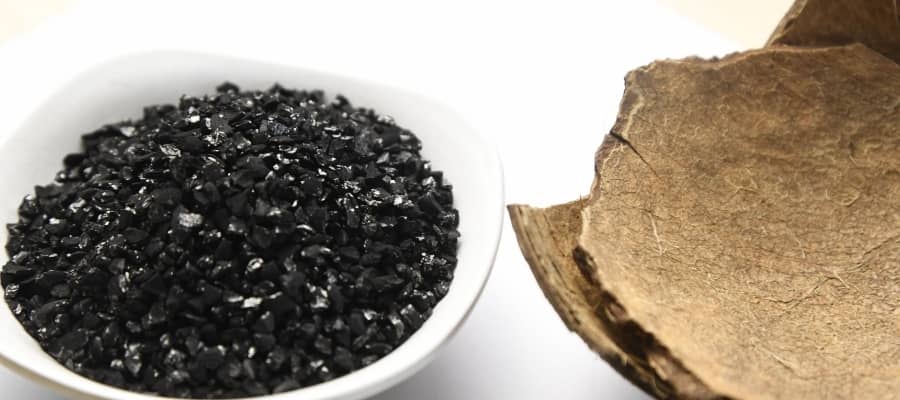
Why Coconut Shell Activated Carbon Is Used in Gold Recovery
Coconut-shell activated carbon is the main route discussed in this guide because gold-recovery circuits need a carbon that can combine adsorption performance with physical strength and controlled particle sizing. The carbon must contact the process solution, retain its particle form in the circuit and remain compatible with the plant’s screens and carbon-transfer equipment.
- Adsorption structure: the activated pore structure provides sites for loading dissolved gold-cyanide complexes.
- Mechanical strength: higher hardness helps reduce breakage and the formation of fine carbon during handling and circulation.
- Controlled sizing: a defined mesh range makes it easier to match the carbon to screens, transfer equipment and circuit design.
- Batch verification: the values that matter for a purchase should be confirmed in the product specification and the COA for the supplied batch.
How Activated Carbon Works in CIP, CIL and CIC
CIP: Carbon-in-Pulp
In a CIP circuit, leaching and carbon adsorption are arranged as separate stages. The carbon is contacted with the gold-bearing pulp after the leaching stage, and the selection focus is usually the interaction between particle size, screen retention, hardness and adsorption performance.
CIL: Carbon-in-Leach
In a CIL circuit, leaching and adsorption take place in the same general train of tanks. Carbon selection should therefore be checked against the circuit’s slurry conditions, carbon movement, screen arrangement and required particle-size distribution.
CIC: Carbon-in-Column
In a CIC circuit, gold-bearing solution passes through carbon columns. This makes hydraulic conditions, column design, screen compatibility and particle-size control especially important. CIC is also used with solution streams associated with some heap-leach operations, but the correct carbon specification must be confirmed from the actual plant design.
For a process-specific explanation, see Qizhong’s activated carbon for gold recovery solution.
How to Select Coconut Shell Activated Carbon for Gold Recovery
The following table separates parameters that can be checked directly from a specification sheet from items that should be confirmed for the actual order. The numerical references below are for Qizhong’s 6×12 / 8×16 coconut-shell granular gold-recovery carbon product and should not be treated as a universal promise for every grade or batch.
| Parameter | Why it matters in the circuit | Qizhong reference or buyer check |
|---|---|---|
| Mesh size | Controls screen retention, contact behavior and carbon transfer. | 6×12 / 8×16 listed for the referenced product; confirm the required distribution. |
| Iodine value | Provides an adsorption-related indicator for comparing a specified grade. | ≥950 mg/g listed for the referenced product; verify the batch COA. |
| CTC | Provides another adsorption-related indicator used in carbon purchasing. | ≥55% listed for the referenced product; confirm the test basis. |
| Hardness | Helps assess resistance to breakage and fine-carbon formation. | ≥98% listed for the referenced product. |
| Ash | Helps the buyer understand the non-carbon mineral content reported for the grade. | ≤5% listed for the referenced product. |
| Moisture | Affects delivered condition and should be checked against the order specification. | ≤5% listed for the referenced product. |
| K-value and R-value | These are application-specific carbon indicators that should be interpreted using the supplier’s test method. | Request the exact reported values and test method on the COA; do not use an unverified fixed range. |
| Platelet and fines | Excessive fines can increase screen loss and complicate carbon handling. | Request the particle-size distribution or screening result for the batch. |
| Screen compatibility | Connects the carbon specification to the actual plant equipment. | Confirm screen opening, transfer method and operating conditions before ordering. |
Choosing the Right Particle Size
6×12 mesh is a common granular specification to evaluate for gold-recovery carbon. 8×16 mesh is another listed Qizhong product option. A request for 6×16 mesh should be treated as a specific target distribution to confirm in the quotation and COA, not as an automatic product claim.
Mesh selection should be connected to the plant’s screens, slurry or solution flow, carbon-transfer equipment and the acceptable level of fine-carbon loss. A nominal mesh label is not enough: ask for the actual distribution, the tolerance and the screening method used for the batch.
2 mm and 3 mm pellet carbon may be considered when a customer’s equipment, column design or operating conditions call for a cylindrical pellet format. It should be selected as a defined equipment-and-specification solution, not presented as a replacement for the main coconut-shell granular route. The product option is listed below for project-specific review.
How Carbon Quality Affects Gold Recovery Operations
- Low hardness: more breakage can create fines and increase carbon loss through screens or transfers.
- Unstable particle sizing: a mismatch between the delivered distribution and the plant screen can affect retention and handling.
- Excessive fines: fines may pass through screening systems or make carbon separation more difficult.
- Insufficient adsorption indicators: the carbon may not meet the purchaser’s target for the intended circuit.
- Batch variation: two deliveries with the same product name can behave differently if their COA values and particle distributions are not checked.
The safest purchasing practice is to compare the TDS, SDS, sample results and batch COA against the same target specification before approving supply.
How to Check a Gold Recovery Carbon Supplier
- Send the supplier the circuit type: CIP, CIL, CIC or heap-leach solution service.
- State the required mesh or pellet diameter and provide the screen or column information that controls the selection.
- Request a TDS, SDS, sample and COA with iodine, CTC, hardness, ash, moisture and the relevant K-value or R-value data.
- Ask how mesh distribution, platelets and fines are checked for the supplied batch.
- Confirm packaging, monthly volume, destination port and the supplier’s ability to maintain the same specification across shipments.
Qizhong Gold Recovery Carbon Options
For the main granular route, review 6×12 mesh coconut shell carbon for gold recovery. For a defined pellet requirement, review the 2 mm or 3 mm activated carbon pellets. The gold recovery application page connects product selection with quotation and project information.
For project context, see the UAE gold-recovery carbon case and the 40-tonne Sudan supply case. These pages should be read as project records and not as universal performance guarantees.
Frequently Asked Questions
Which coconut shell activated carbon is suitable for CIP?
Start with a coconut-shell granular grade whose mesh distribution, hardness, adsorption indicators and screen compatibility match the CIP circuit. The 6×12 / 8×16 product specification is a starting point for a quotation; the final grade should be confirmed against the plant’s COA requirements.
What mesh size is commonly used in gold recovery?
6×12 and 8×16 are common specifications to evaluate. The correct choice depends on the circuit’s screens, carbon-transfer equipment and operating conditions, so the actual distribution should be confirmed rather than relying on the label alone.
When would a 2 mm or 3 mm pellet be selected?
A 2 mm or 3 mm pellet may be selected when the customer’s equipment, column or operating conditions require a cylindrical format. It is a specific supplemental route and should be matched to the equipment and target COA.
Which values should be checked on the COA?
Check mesh distribution, iodine, CTC, hardness, ash, moisture and any K-value or R-value requested by the project. Also confirm the test methods, batch number and whether the COA corresponds to the shipment.
How does hardness affect carbon loss?
Hardness is a practical indicator of resistance to breakage. If carbon breaks into fines, more material may be lost through screens or become harder to handle. The effect should be assessed together with the plant’s screen design and operating conditions.
Request a Sample, COA or Quotation
To recommend a suitable coconut-shell gold-recovery carbon, send the circuit type, required particle size, target specifications, monthly volume, destination port and any current COA or test data. Qizhong can then confirm whether the 6×12 / 8×16 granular route or a specific 2 mm / 3 mm pellet route fits the stated requirement.