
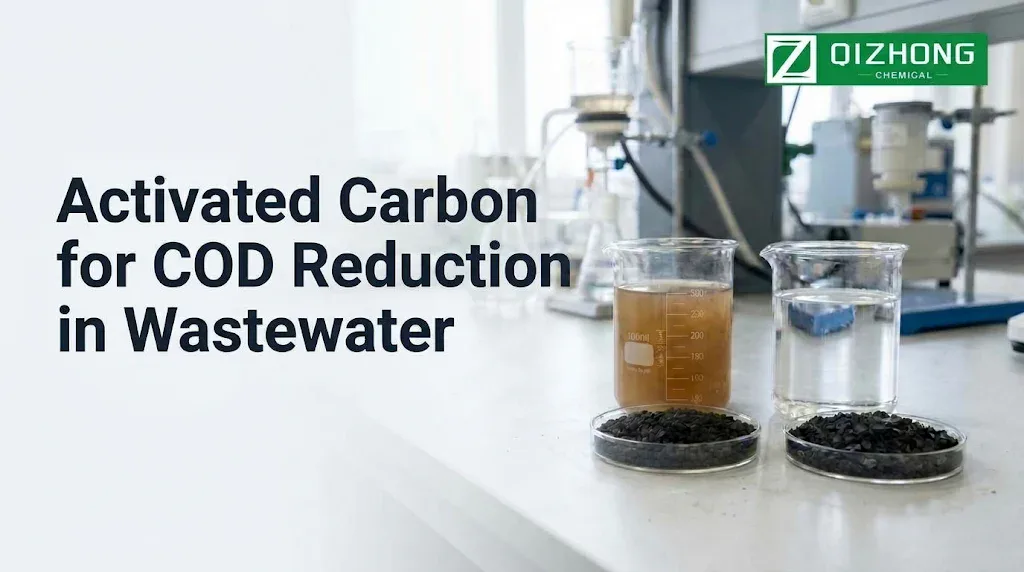
Tightening discharge limits and fluctuating chemical oxygen demand (COD) are among the most common compliance pressures in industrial wastewater treatment. Activated carbon is not a universal adsorbent in this picture. It works as a polishing step: through its micropores it removes the adsorbable organic fraction, especially the refractory compounds that biological treatment leaves behind. Its COD removal is selective — carbon takes out the molecules your wastewater can adsorb, not the total COD value.
This guide explains how activated carbon reduces COD, where the step belongs in a treatment train, which parameters matter when choosing a grade, and what to confirm before ordering. It is written for operators, process engineers and buyers who answer for a discharge limit. If you are still mapping activated carbon’s broader role in water applications, our activated carbon for water treatment guide is useful background reading.
🚀 Key Takeaways for Procurement Pros
- Activated carbon removes COD selectively: it adsorbs the adsorbable organic fraction, not the total COD.
- The most effective placement is tertiary polishing after biological treatment. As a rule of thumb, raw wastewater above roughly 2000 mg/L COD is rarely economical to treat with carbon as the main process.
- Particle size, iodine value, hardness and ash are the parameters that decide whether a grade fits COD service.
- Iodine value is not a COD removal guarantee. Verify with a bench test on your actual water sample.
- For an inquiry, prepare your application and target parameter, known water data, estimated quantity and destination port.
1. Why COD Keeps Missing the Limit
COD is defined as the oxygen equivalent consumed when a strong oxidant — potassium dichromate in the standard method — oxidizes the reducible substances in a water sample, reported in mg/L. The single number can stand for dozens or hundreds of different compounds: phenols, dyes and dye intermediates, surfactants, oils, humic substances, and certain inorganic reducers such as ferrous iron and sulfide.
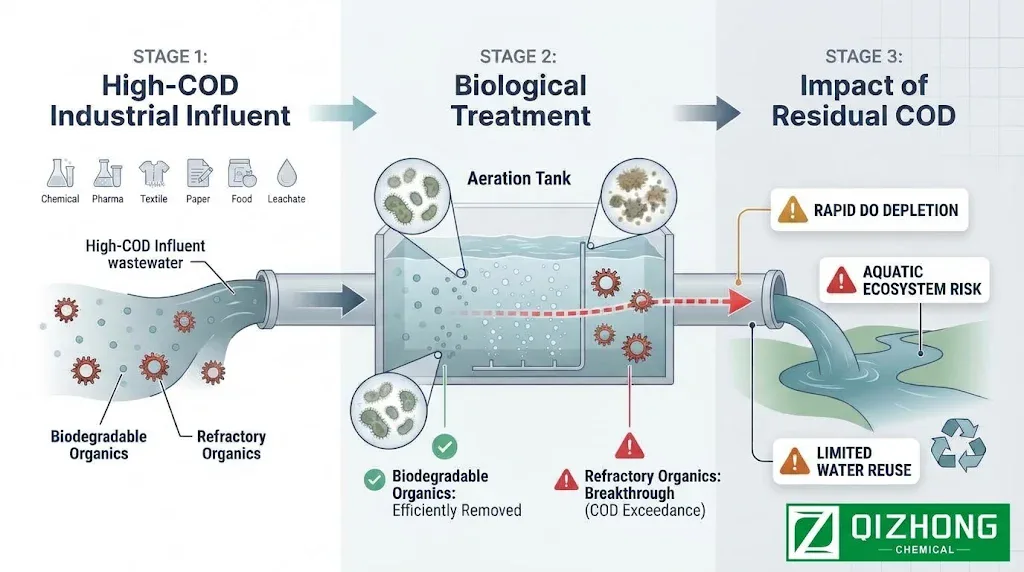
Biological treatment removes the biodegradable share of this load efficiently, but refractory organics pass through the bioreactor largely untouched. That is why COD often lingers just above the limit after every other parameter looks settled. Effluents from chemicals, pharmaceuticals, textiles and dyeing, paper, and food processing carry higher shares of these compounds, and landfill leachate is a well-known difficult case. COD is not only a compliance number, either: discharged to a river, it consumes dissolved oxygen quickly and stresses aquatic life, and it matters for any downstream reuse scheme.
2. How Activated Carbon Removes COD — and Where It Fits
Activated carbon removes dissolved organics mainly through physical adsorption. Its micro- and mesopore network provides an enormous internal surface area, and organic molecules are captured inside the pores; surface oxygen groups add a chemical interaction with polar compounds. The selectivity follows directly from this mechanism. Small aromatic molecules, phenols and dye molecules adsorb well. Small hydrophilic molecules such as low alcohols adsorb poorly. Inorganic reducers contribute to the COD reading but are not removed by carbon, so they should not be counted in any performance expectation. For a wider view of carbon in wastewater service, see our activated carbon in wastewater treatment overview.
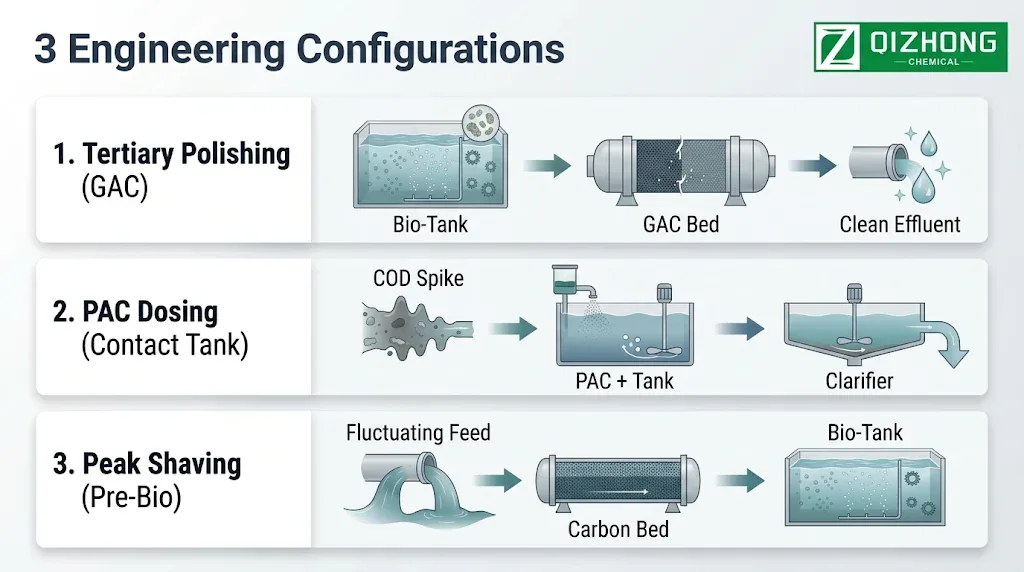
In practice the step appears in three positions. A granular activated carbon (GAC) bed after biological treatment is tertiary polishing: it shaves peaks continuously and removes refractory residuals, and it is the most common configuration behind a COD limit. Powdered activated carbon (PAC) dosing answers shock loads or seasonal excursions — fast to start and flexible, with the carbon dose becoming an operating cost. Some plants also place a carbon bed ahead of the biology to trim influent peaks and protect the bioreactor.
One general engineering reference: when raw wastewater COD runs persistently above roughly 2000 mg/L, carbon as the main treatment is rarely economical, because the carbon consumption becomes prohibitive. Physicochemical or biological treatment should bring the load down first; carbon then polishes the remainder. This is industry practice, not a supplier guarantee.
3. Choosing a Grade: The Parameters That Matter
Grade selection is about matching pore structure and operating format to your water and equipment, not chasing the highest single number.
Pore structure comes first. COD targets dissolved organics, and a carbon with well-developed micropores holds more low-molecular-weight organics per gram. Coconut shell carbon is the classic liquid-phase choice here — roughly 80–90% of its pore volume sits in the micropore range as a general industry figure, which our coconut shell activated carbon guide explains in detail. Iodine value indicates how far the pore system has developed, with typical coconut shell grades running 850–1200 mg/g, but it measures iodine adsorption, not your wastewater’s COD capacity.
Particle size decides the operating format. Fixed beds commonly use water-treatment granulations such as 8×30 or 12×40 mesh; dosing systems use fine 200–325 mesh powder for faster adsorption kinetics. Hardness matters most in backwashed GAC beds, where soft carbon sheds fines that clog the bed and shorten run length. Low ash reflects product cleanliness.
The PAC-or-GAC decision follows the operating pattern: a continuously discharging plant that must hold a limit buys a GAC bed and schedules change-outs; a plant facing intermittent or seasonal excursions doses PAC on demand.
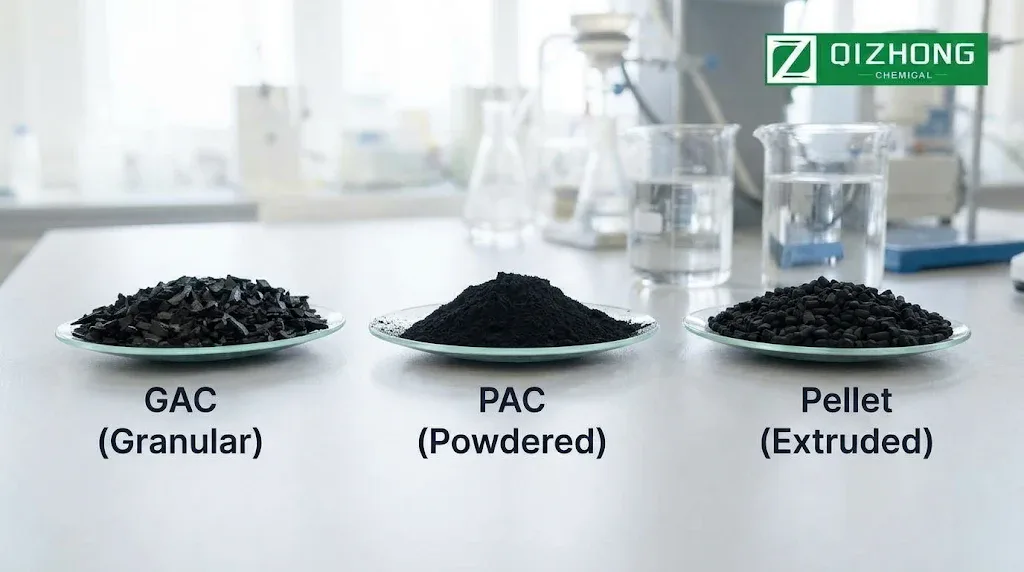
The coconut shell activated carbon series covers granular, powdered and pellet forms:
| Product | Form and particle size | Key parameters |
|---|---|---|
| Coconut shell granular (GAC) | 4×8, 4×12, 6×12, 8×16, 8×30, 12×40, 20×50, 30×60 mesh | Iodine value 850–1200 mg/g; hardness 97–99%; ash <3% |
| Coconut shell powdered (PAC) | 200–325 mesh | Iodine value 850–1200 mg/g; ash <3% |
| Coconut shell pellet | 3 mm, 4 mm diameter | CTC 60–120%; hardness >98% |
Values are typical ranges. Iodine value does not represent a COD removal promise for any specific wastewater — run the bench test described below before fixing a grade.
4. Run a Bench Test Before You Buy
Neither the iodine value nor any published figure replaces a measurement on your own water. A jar test with PAC produces a dosing curve; a small GAC column produces a breakthrough curve. Both give you the two numbers that decide the investment: how much COD each gram of carbon removes, and how long a bed lasts before the effluent reaches your limit. Literature removal rates for tertiary polishing commonly fall in the 30–60% range, but the adsorbable fraction varies widely between effluents, so treat those figures as orientation only.
When you request a quotation, include your inlet and outlet COD with its fluctuation range, the flow rate, the existing treatment chain and the target limit. Our guide on how to purchase activated carbon covers the full inquiry checklist.
5. Work with Qizhong Chemical on COD Reduction
If you are engineering a carbon step for COD compliance, tell us what you are treating. Prepare your application and target contaminant, the water data you have, and your estimated quantity and destination port. We will suggest a grade, arrange a sample for bench testing and prepare a quotation. You can also review the water treatment applications page or reach us through the contact page.
Email: info@qizhongcarbon.com
Phone / WhatsApp: +86-19137612950
Frequently Asked Questions
Can activated carbon remove all COD?
No. Carbon removes the adsorbable fraction — mainly refractory dissolved organics such as phenols and dye compounds. Small hydrophilic molecules and inorganic reducers are poorly adsorbed or untouched. That is why a bench test on the actual water comes before any purchasing decision.
What COD removal rate should we expect?
It depends on the adsorbable share in your effluent. Published tertiary polishing results commonly fall between 30 and 60 percent, with some cases higher, but these are orientation figures rather than a promise. Your jar test or column test decides.
Should we use PAC or GAC?
GAC fixed beds fit continuous discharge with a standing limit; PAC dosing fits shock loads, seasonal excursions or a quick check of feasibility. Many plants run both — GAC holds the baseline while PAC handles peaks.