
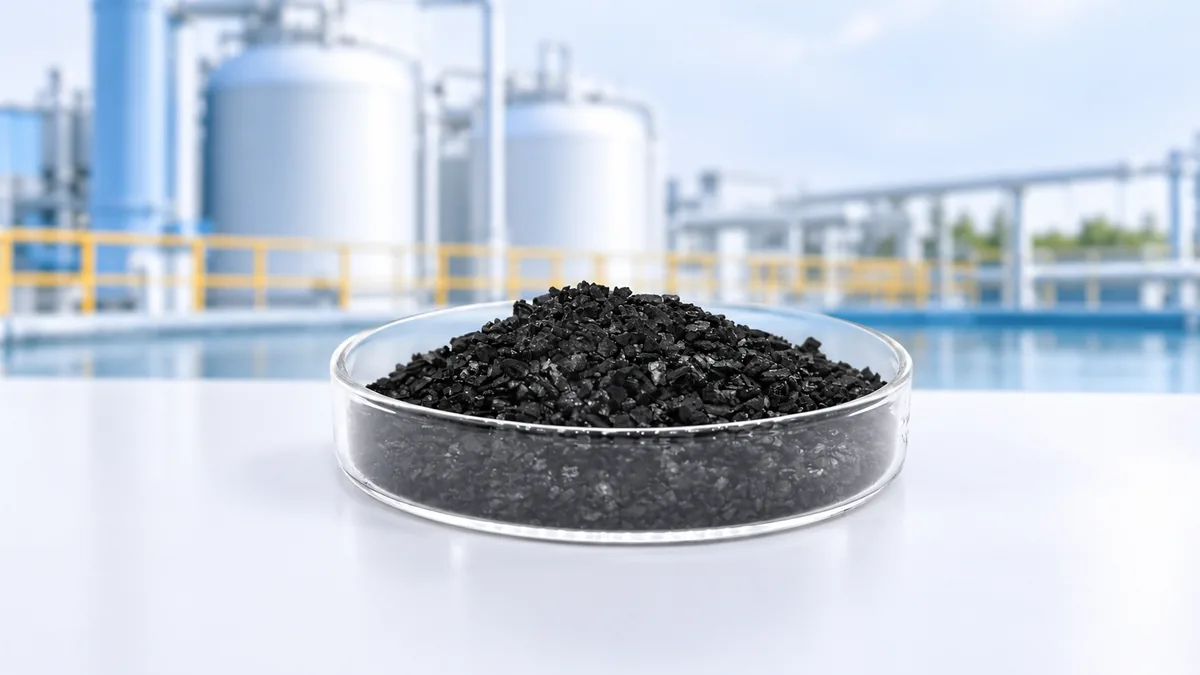
MDEA (methyldiethanolamine) is one of the most widely used solvents for gas sweetening in natural gas processing and refinery gas plants. It circulates between the absorber and the regenerator, removing H₂S and CO₂ from the feed gas. As the unit runs, the solution gradually accumulates degradation products, heat-stable salts, dissolved hydrocarbons and surface-active materials — the main causes of amine foaming, equipment corrosion and solvent loss.
The activated carbon bed installed on the lean amine side is the key step that adsorbs these dissolved organic contaminants out of the circulating solution. This article follows the unit’s actual sequence: where the contaminants come from, what activated carbon removes and what it cannot, where the carbon bed belongs and how it is designed, and how to choose the right grade against specifications.
Key Takeaways
- The core role of activated carbon in an MDEA system is to adsorb dissolved organic contaminants — surfactants, dissolved hydrocarbons and degradation products — controlling foaming, reducing corrosion risk and cutting amine make-up.
- The bed treats dissolved impurities only. Suspended solids such as iron sulfide must be caught by upstream 5–10 μm mechanical filters, and inorganic heat-stable salts require dedicated processes such as ion exchange.
- The industry-standard configuration is a lean-side slipstream carbon bed treating 10–50% of total circulation, with a contact time of at least 15 minutes and mechanical filtration on both sides of the bed.
- Coal-based granular carbon in 8×30 mesh is the most common grade for amine service. Iodine value, molasses number, hardness, bulk density and ash are the parameters that matter most when comparing specifications.
- Final selection should be confirmed with a foam test on your own amine sample — carbons from different raw materials behave differently in foam control.
Why MDEA Solutions Get Contaminated
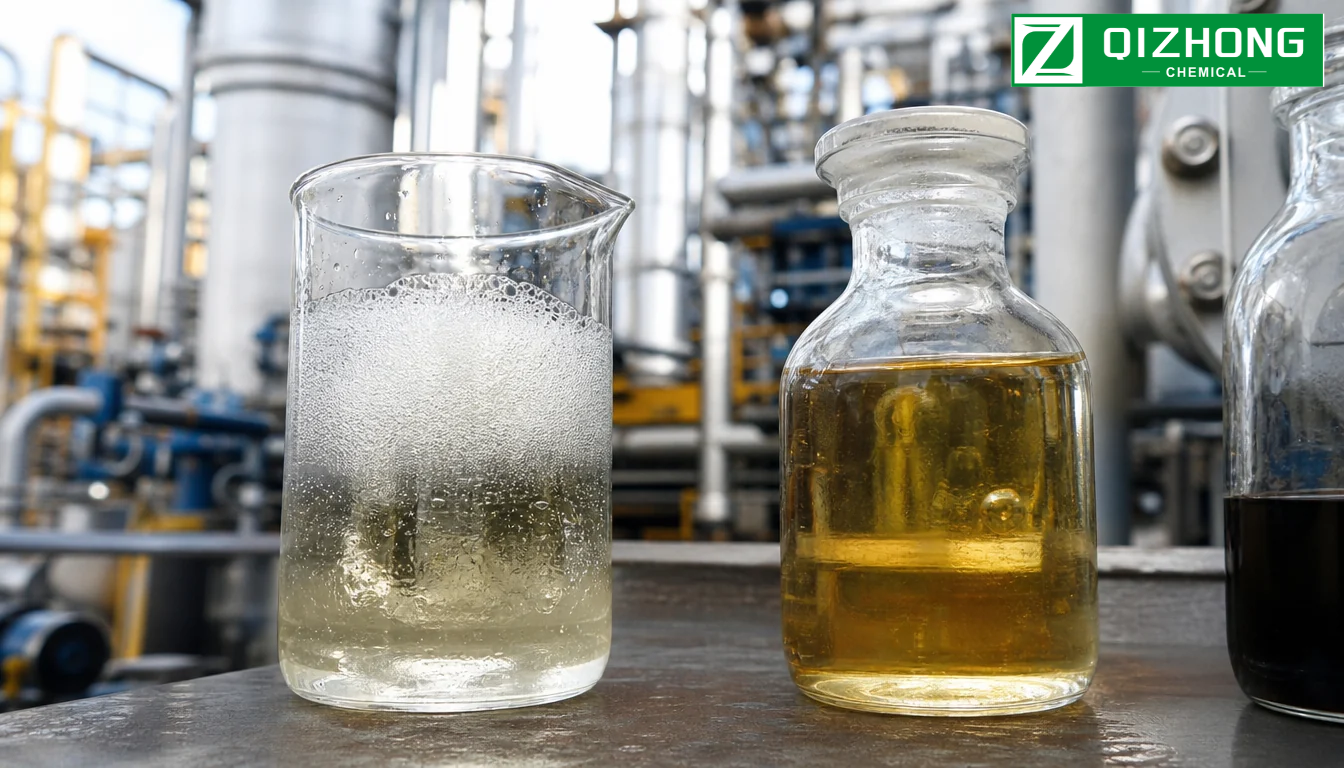
MDEA is a tertiary amine with better chemical stability than MEA or DEA, which is one reason it became the mainstream solvent. Stability does not mean freedom from contamination — contaminants enter the solution continuously. There are three main sources. Oxidative degradation in contact with oxygen produces small organic acids such as formic and acetic acid, and thermal degradation in the hot regenerator produces nitrogen-containing by-products. Heat-stable salts form when the amine reacts with CO₂, H₂S, O₂ and trace impurities in the feed gas — formates, acetates, thiosulfates, sulfates and chlorides. They do not break down at regeneration temperature, accumulate over time, reduce absorption capacity and accelerate corrosion. Finally, condensate, compressor oil and corrosion inhibitors carried over from the feed gas act as surfactants in the solution.
These surfactant-type contaminants adsorb at the gas–liquid interface and trigger foaming — the most direct cause of amine unit upsets. Foaming reduces mass-transfer efficiency, carries amine out of the system with the gas, cuts treating capacity and, in severe cases, forces the unit to reduce throughput or shut down; industry literature consistently ranks foaming among the most common single causes of amine-unit operating losses. Heat-stable salts and degradation products also accelerate heat-exchanger and regenerator corrosion and raise amine make-up cost.
On the purchasing side this demand usually arrives as a defined grade and quantity. Tender specifications in the CIS market, for example, name 8×30 mesh granular carbon with acceptance parameters such as iodine value and bulk density, and suppliers deliver by volume with the total net weight converted from bulk density. Understanding what these parameters mean is the first step in both selection and negotiation.
What Activated Carbon Removes and What It Cannot
The carbon bed adsorbs organic molecules through van der Waals forces and dipole interactions. It performs well on dissolved hydrocarbons, surface-active materials — including antifoam agents that were overdosed in the first place — amine degradation products and color bodies, and it also adsorbs some organic-acid heat-stable salts. The boundaries are just as clear.
Suspended solids are not its job. The carbon bed is not a filter: fine iron sulfide colloids can pass straight through, and they must be caught by an upstream mechanical filter rated at 5–10 μm. In a healthy system there should be no significant pressure drop across the carbon bed — a rising differential pressure means upstream filtration is failing and solids are plugging the bed. Inorganic heat-stable salts are also out of scope: chlorides, sulfates and similar ions are barely adsorbed and need ion exchange or equivalent processes. Low-molecular-weight organic acids are only partially adsorbed and keep accumulating. This explains a familiar field puzzle — a freshly changed carbon bed and the foaming problem persists — because the contaminant driving the foam may be outside the bed’s capability altogether.
One more interaction is easy to miss: most antifoam chemicals are themselves surface-active and are directly adsorbed by the carbon bed. The common site cycle of “dose antifoam, brief improvement, then it gets worse” is the antifoam and the carbon bed consuming each other. The root cause still has to be solved with a clean solution.
Where the Carbon Bed Goes in the Unit
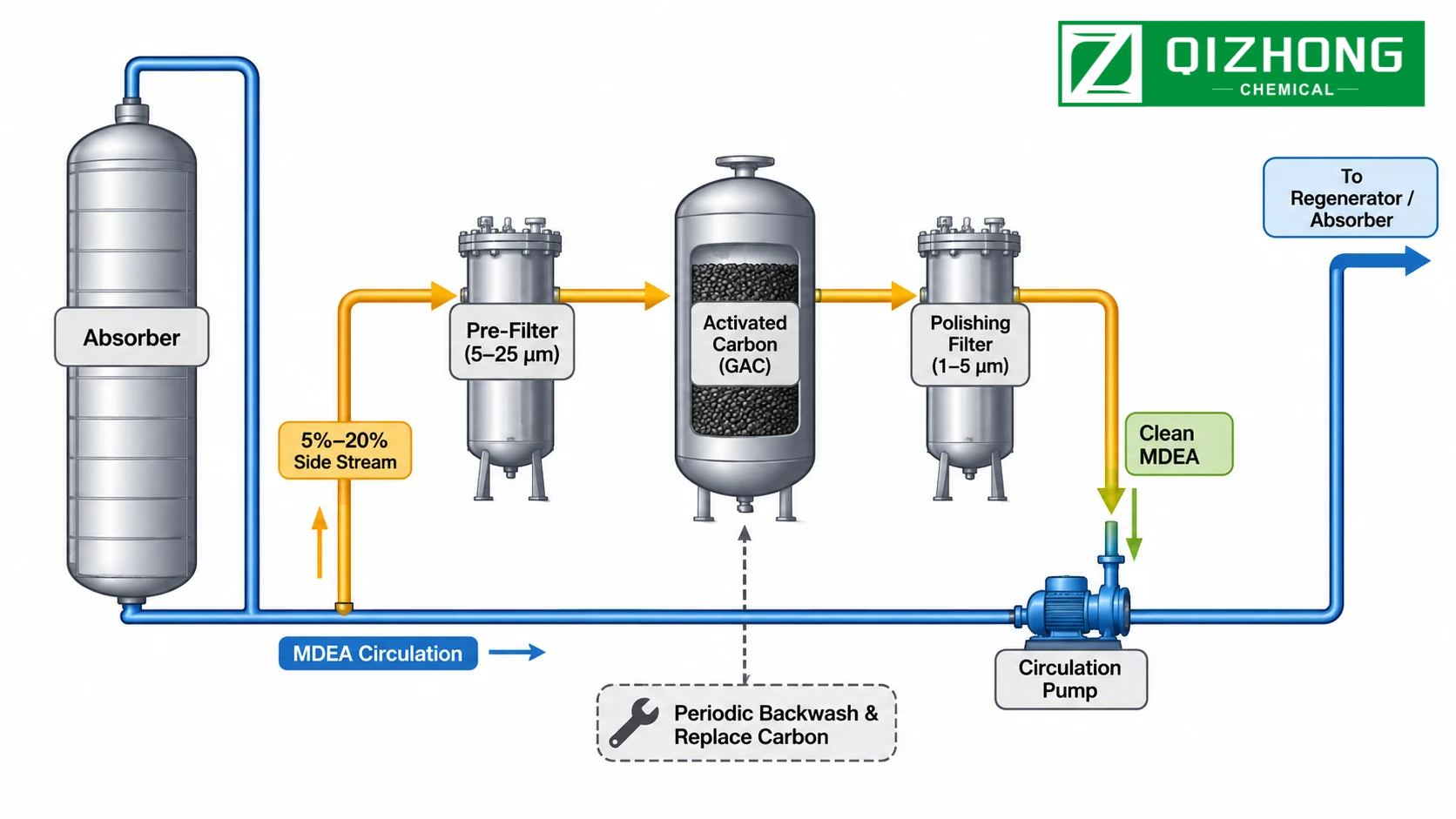
The standard location is the lean amine side: after the regenerator and the cooler, a slipstream of the regenerated solution is routed through the carbon bed and returns to the system before the absorber. The rich side is unsuitable for two reasons. Rich amine carries large amounts of acid gas, which would form gas pockets inside the bed, block the flow path and can stop flow entirely; and the high H₂S environment on the rich side makes bed change-out unsafe for maintenance personnel. Engineering practice on these two points is consistent.
A complete carbon filtration system has three parts: an upstream particulate filter at 5–10 μm that protects the bed from suspended solids, the activated carbon bed that adsorbs the dissolved contaminants, and an after-filter that catches carbon fines generated in operation before they reach the absorber.
Three design numbers are worth remembering. The slipstream typically treats 10–50% of total circulation — many units are designed at 10–20%, and some best-practice guidance recommends at least 25%, because a higher slipstream keeps the steady-state contaminant concentration lower at the cost of bed size and pumping. Contact time should be at least 15 minutes: laboratory studies on contaminated refinery MDEA showed that 15 minutes of contact significantly reduced foaming and restored interfacial tension, and longer contact times brought the solution close to foam-free. A conventional bed of 8×30 mesh carbon normally meets this requirement. Most beds are vertical vessels with downflow operation.
Choosing the Grade
Type. Coal-based granular carbon is the mainstream choice for amine units. Coal-based carbon has a balanced distribution of micropores, mesopores and macropores, and amine contaminants span a wide molecular size range — from small organic acids to oils and corrosion inhibitors — which is exactly what this pore structure covers.
Particle size. The most common size is 8×30 mesh (about 0.6–2.36 mm): moderate pressure drop, and the factory-default configuration for most amine carbon filters. Where lower pressure drop is needed, 4×10 or 8×16 mesh can be used, at slightly slower adsorption kinetics.
Raw material. Laboratory studies that compared carbons from different raw materials on DEA and MDEA foaming found coal-based carbon more effective for DEA solutions and coconut shell carbon more effective for MDEA. Coal-based 8×30 remains the industry standard in practice, one reason being that amine contaminants are mostly hydrophobic organics, which the more developed mesopore structure of coal-based carbon tolerates well. Raw material shapes the pore structure and surface chemistry, and grades from both directions are used in real plants; final selection should be confirmed with a foam test on your own amine sample, which is why we recommend starting with a sample evaluation.
Qizhong Product Specification for Reference
For amine service, Qizhong supplies coconut shell granular activated carbon to the customer’s specification, with mesh size and iodine grade customized to the application. The published general specification is as follows. Read More
| Parameter | Qizhong coconut shell granular activated carbon |
|---|---|
| Iodine number | 850–1200 mg/g |
| Hardness | 97–99% |
| Ash content | <3% |
| Particle size | Customizable to requirement; 8×30 mesh commonly used for amine service |
How to read the parameters: iodine value indicates total adsorption capacity, mainly micropore capacity for small molecules. Molasses number reflects mesopore development, which matters more for the large molecules in amine contamination — oils and corrosion inhibitors. Hardness and attrition value determine the dust generated during loading and operation, which is the direct load on the after-filter. Bulk density connects purchasing with engineering: when buying by volume in cubic meters, multiply by bulk density to get net weight and freight; when buying by tonnage, divide by bulk density to get the bed volume. Ash and moisture affect the effective loading actually installed. For amine applications these indicators predict field performance better than surface area alone.
Frequently Asked Questions
How often should the carbon bed be changed?
There is no universal interval — it depends on the contamination load of the unit. The practical approach is to track solution cleanliness trends with color, TOC and laboratory shake-foam tests, and schedule the change-out when foam test results start to deteriorate. A spent carbon bed not only loses treating capacity, it can become a release source for the contaminants it captured.
Can the carbon bed replace mechanical filters?
No. The two have different jobs: the carbon bed removes dissolved organics, mechanical filters remove suspended solids. Iron sulfide fines can pass through a carbon bed — using the bed as a filter fails at both tasks.
Why can’t the bed be installed on the rich amine side?
Two reasons. The acid gas dissolved in rich amine forms gas pockets inside the bed and blocks the flow path, and the high H₂S concentration on the rich side makes bed change-out unsafe for maintenance personnel.
Is a higher iodine value always better?
Not necessarily. Iodine value mainly reflects micropore capacity for small molecules, while a significant share of amine contaminants are larger molecules. Molasses number and a foam test on the actual amine sample predict field performance better than iodine value alone.
Conclusion
A properly designed carbon bed is one of the lowest-cost, most direct-return treatment steps in an amine unit: with the right grade and parameters, foaming stays under control, amine losses drop and solution life extends. The reverse is also true — a wrong grade, or a bed running past its service life with upstream filtration failing, is a cleanliness problem that cannot be bought back.
To get a grade recommendation for your unit, prepare: the amine type (MDEA or a formulated amine) and concentration with circulation rate; the main problem you are addressing (foaming, corrosion, amine loss, discoloration); your existing filtration configuration — whether a carbon bed is installed, its mesh size and change-out frequency; and if you already have a specification sheet or grade number, for example from a tender, send it to us for direct comparison.
Contact Us
We provide complete documentation with every offer: technical datasheet, lot-specific Certificate of Analysis, SDS, photos of the original bag labels, and sample testing before packing. Send us your amine type, concentration, circulation rate and purchase quantity — Qizhong Chemical will recommend a suitable grade, arrange samples for foam testing, and prepare a quotation. You can also review our granular activated carbon products, our coconut shell activated carbon line, or the oil and gas applications page, or reach us through the contact page.
Email: info@qizhongcarbon.com
Phone / WhatsApp: +86-19137612950