
The short answer
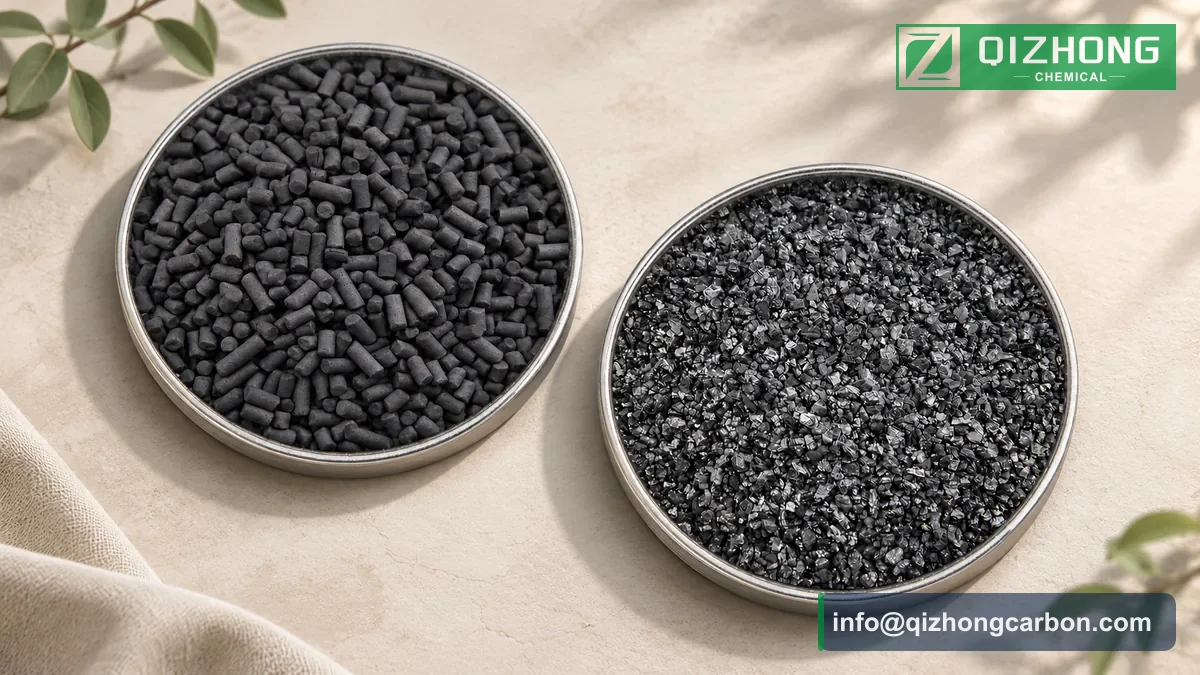
For water-treatment filter beds, granular activated carbon is usually the first option to assess. For industrial gas fixed beds where airflow resistance matters, pellet activated carbon is usually worth evaluating first. Granular carbon consists of irregular particles and is commonly supplied by sieve size. Pellet carbon is extruded into cylindrical pellets and is commonly specified by diameter.
The real trade-off is not simply “granular versus pellet.” It is the particle size and flow conditions the equipment requires, together with the adsorption performance the treatment target demands. Pellet shape does not automatically mean higher capacity, and granular carbon does not automatically mean a lower price. The sections below compare the two forms and explain when each is a sensible starting point.
In industrial water-treatment and gas-purification projects, you may receive two very different-looking activated-carbon proposals: one with irregular black granules and another with neat, small cylinders. Both can be used for adsorption, but once loaded into the same type of equipment, they may differ in pressure drop, bed behavior and suitability for the operating conditions.
Selection does not need to begin with a long list of specifications. First identify which form fits the equipment and application, then compare treatment performance. This usually makes it easier to identify products worth sampling and requesting a quotation for.
What is granular activated carbon?
Granular activated carbon (GAC) is a particulate adsorbent with an internal pore structure; in this comparison, it means irregular granular carbon as distinct from extruded cylindrical carbon. It can be manufactured from raw materials such as coal or coconut shell through carbonization, activation, crushing and sieving. Some manufacturing routes first agglomerate and further process the raw material into granules. Therefore, “granular carbon” describes product form; it does not identify one particular raw material or process.
Specifications are commonly stated as a sieve-size range, such as 8×30 mesh or 12×40 mesh. The two numbers describe the sieve range, not the length and width of one particle. Qizhong’s granular activated carbon range includes both of these sizes, as well as other available particle-size options.
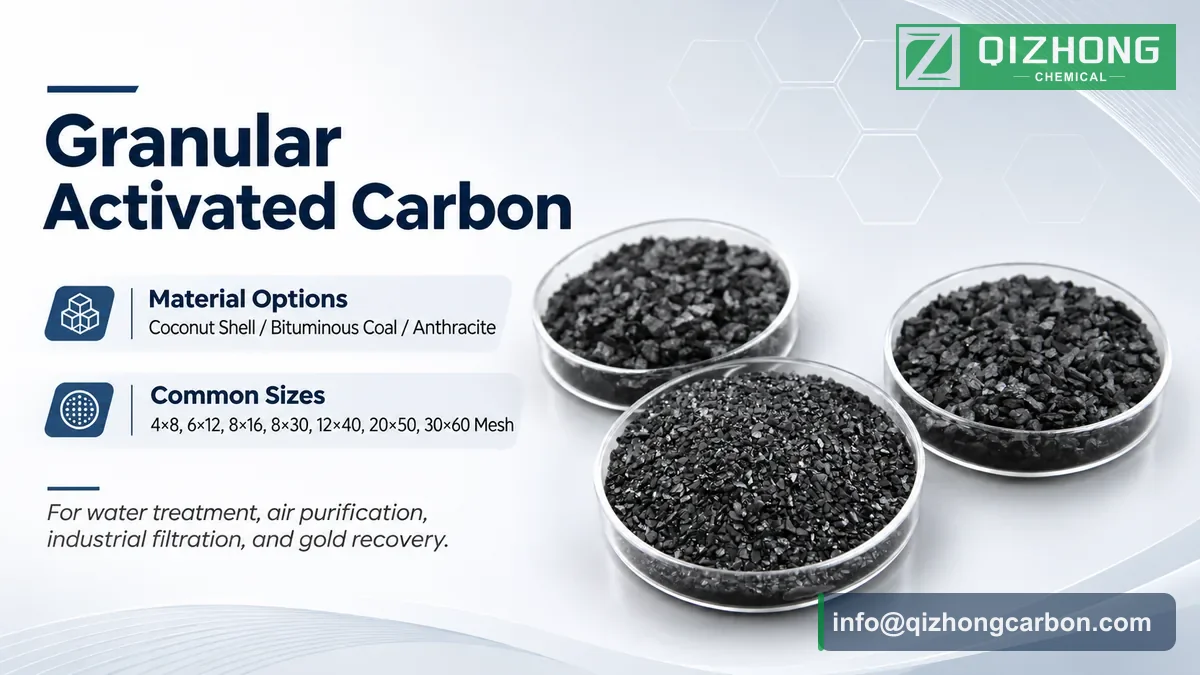
Granular carbon is common in water-treatment adsorption beds, and grades are also available for air and gas purification. In water-treatment equipment, selecting the appropriate size is the starting point for matching bed pressure drop, adsorption contact and backwash conditions.
- Main advantages: A broad choice of raw materials and sieve sizes makes it easier to match existing water-treatment beds and different adsorption duties.
- Main limitations: Finer is not always better. Reducing particle size may support mass transfer, but it can also increase bed pressure drop. Abrasion resistance and fines content depend on the specific grade.
What is pellet activated carbon?
Pellet activated carbon is activated carbon formed by extrusion into cylindrical pellets; it is also called extruded activated carbon. A typical manufacturing route involves formulation, extrusion, and the relevant carbonization and activation steps. Forming controls the external dimensions, while activation develops the internal pore structure; each serves a different purpose.
Pellet carbon is usually specified by diameter, for example 3 mm or 4 mm. Pellets with the same diameter may still have different length distributions. Qizhong’s pellet activated carbon range includes these two diameters and other options; actual loading should also take pellet-length distribution into account.
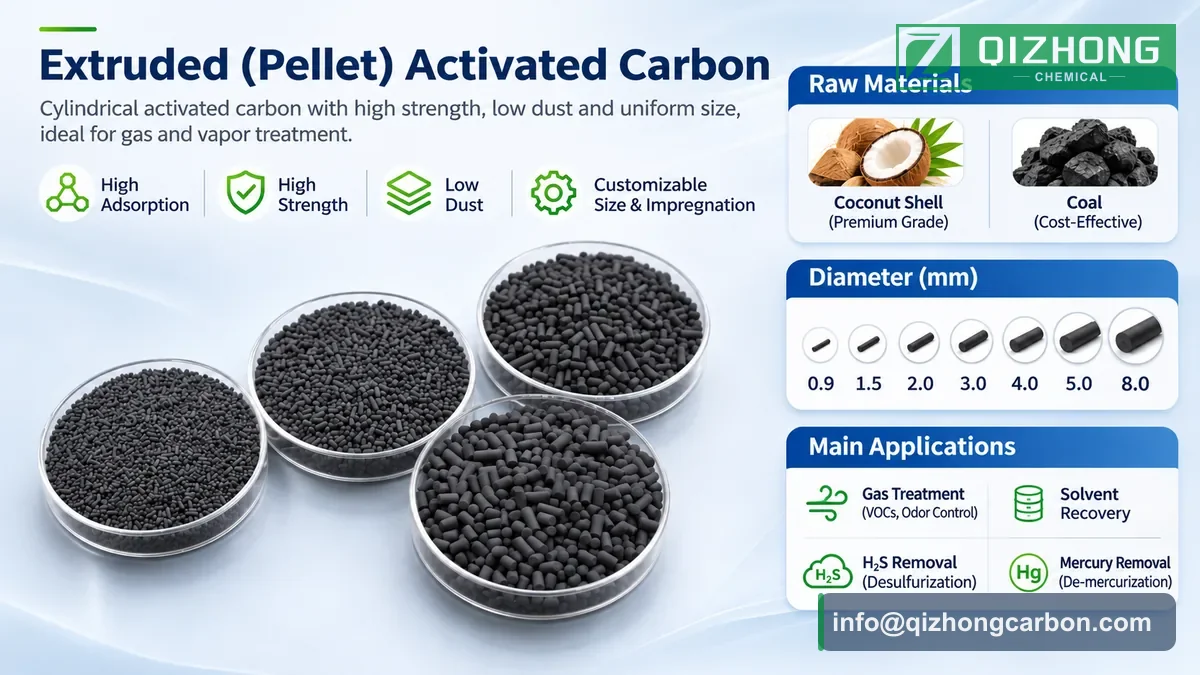
This form is commonly used in industrial exhaust treatment, air purification and solvent recovery fixed beds. Its regular shape and available diameters make it a common candidate for gas-phase beds designed around lower pressure drop. High-strength and low-dust grades can also help reduce particle breakage during loading and operation.
- Main advantages: The regular shape is convenient for matching gas fixed beds by diameter, with grades available to balance strength, dust and flow requirements.
- Main limitations: A larger diameter does not automatically produce better treatment. Particle dimensions, contact time and the target contaminant still need to match, and some water-treatment applications require grades specifically suited to that service.
Granular vs pellet activated carbon: comparison at a glance
| Comparison point | Granular activated carbon | Pellet activated carbon |
|---|---|---|
| Form and specification | Irregular particles; commonly selected by sieve range, such as 8×30 or 12×40 mesh | Cylindrical pellets; commonly selected by diameter, such as 3 or 4 mm, with length matched separately |
| Typical starting point | Water-treatment adsorption beds; gas-phase grades are also available | Industrial gas fixed beds; grades for water treatment are also available |
| Flow resistance | Particle-size selection is important; coarser granules can also be used in gas-phase beds | A common candidate for lower-resistance gas beds; actual performance still depends on dimensions and bed conditions |
| Adsorption performance | Select raw material, pore structure and grade according to the target contaminant | Select the grade according to the target contaminant as well; regular shape does not mean higher capacity |
| Strength and dust | High-abrasion-resistance grades are available; water treatment requires a match to backwash conditions | High-strength and low-dust grades are available for the relevant gas-bed requirements |
| Economics | Compare the cost to load one bed, energy use and replacement cost | Calculate loading cost in the same way, while also considering energy associated with gas-phase pressure drop |
Which is better for water treatment or gas purification?
For a conventional water-treatment application, granular carbon is usually the more direct starting point. It is available in different raw materials and sieve sizes, making it easier to continue using the filter-media specification already built into the equipment and to match water flow and backwash conditions. When replacing carbon in an existing bed, if the original design specifies a granular size, it is generally more reliable to first look for a suitable grade in the same form rather than change the form immediately.
For an industrial air or gas-treatment application where ventilation resistance is important, pellet carbon is worth prioritizing for evaluation. Industrial odor or solvent-vapor treatment, for example, requires not only a suitable adsorbent but also enough airflow through the carbon bed within the permitted pressure drop. Pellet carbon has established product choices for these applications.
The two forms do overlap in use: granular carbon is also used in gas-phase fixed beds, and some pellet grades are suitable for water treatment. If existing equipment is operating well, there is no need to change the media design simply because the other form is more common in a particular field.
The starting point is clear: begin with granular carbon for conventional water-treatment beds, and evaluate pellet carbon first for lower-resistance industrial gas beds. For existing equipment, use the original design specification as the basis for finding an alternative grade.
Which form has lower flow resistance?
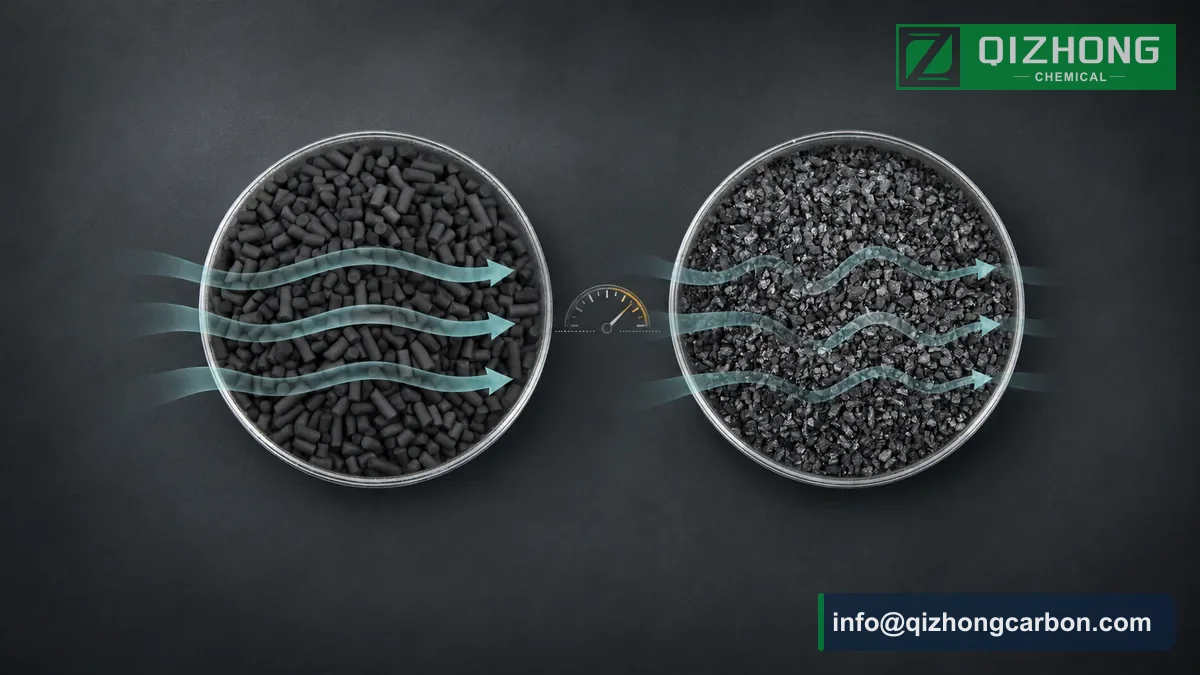
In gas-phase systems, pressure drop affects whether the fan can deliver the target flow rate and how much energy the system consumes. The regular shape and available diameters of pellet carbon make it suitable for matching a lower-resistance bed; this is one reason it is frequently considered for industrial gas purification.
With granular carbon, sieve size must be considered at the same time. Coarser granules can also be used in gas beds. Finer particles may shorten the internal diffusion distance, but they often create higher pressure drop. When comparing resistance, therefore, consider particle dimensions as well as form.
When comparing two candidate grades, ask the supplier for pressure-drop data under the same gas conditions, actual flow rate and bed geometry. Only then can you judge which specification will consume more of the fan’s available pressure margin.
When fan pressure margin is limited, screen specifications first using pressure drop at the target flow rate. A suitable pellet grade is worth prioritizing; however, there is no reason to replace an existing low-resistance coarse-granule solution solely to change the product form.
Which form provides better adsorption?
If the question is “which form can treat more contaminant with the same tonne of carbon?”, the answer starts with the material grade, not the external shape. Much of activated carbon’s adsorption surface lies inside its pore structure. Raw material, activation and surface treatment all affect performance against different substances. Forming carbon into regular small cylinders does not automatically increase capacity for the target contaminant.
Particle size is one adjustable feature of granular carbon. For otherwise comparable materials, smaller particles generally shorten the internal diffusion path and can improve adsorption rate, but a faster rate does not mean a higher saturation capacity. Pellet carbon is also available in different diameters, so it should not be treated as being “always coarser and slower” than granular carbon.
For example, ordinary VOC adsorption should be compared using the target compound at the relevant concentration, temperature and humidity. Where impregnation is required, first screen formulations suitable for the target gas. Both granular and pellet products can be available in modified grades; impregnation is not exclusive to either form.
Iodine number or CTC can help describe a product’s specified test performance, but neither replaces a comparison of actual treatment capacity for every contaminant.
Adsorption performance should not be decided by product form alone. Request working-capacity or breakthrough data for the target contaminant under the specified operating conditions, then compare it with the required contact time. This answers “which one can treat more?” more effectively than comparing iodine numbers alone.
Which is more durable and produces less dust?
Some pellet-carbon grades are designed for high mechanical strength and low dust, making them suitable for gas systems where reducing loading damage and fines in the bed is important.
High-strength granular-carbon products are also available. Raw material and manufacturing route affect finished-product strength. In applications involving backwashing or conveying, an appropriately specified granular grade should not be excluded simply because its particles are irregular.
For procurement, compare hardness or abrasion-resistance values using the same test method, then consider initial fines and the actual operating conditions. In water treatment, wear during backwashing deserves attention; in gas-phase beds, loading breakage and dust control are often more immediate concerns.
For gas beds, focus on loading breakage and fines; for backwashed filter beds, focus on abrasion resistance. The former can start with low-dust pellet grades, while the latter should start with a wear-resistant granular grade that meets the equipment requirements.
Which form has the lower total cost?
Granular carbon is not necessarily cheaper, and pellet carbon is not necessarily more expensive. Raw material, activation level, post-treatment and purchasing specification all affect the quotation. Only quotations for specific grades under the same purchasing conditions can answer which has the lower purchase price.
Operating cost requires one more step. If granular carbon can use the existing water-treatment bed specification, it may avoid the need to rematch equipment after changing the media. If pellet carbon meets the lower-resistance requirement at the target gas flow, it may offer an advantage in fan energy.
The carbon weight required to fill the same bed volume may also differ. Looking only at price per tonne can hide loading quantity, energy, replacement frequency and disposal costs. Compare these costs over the same treatment volume or operating period.
A more practical price comparison is: first calculate the cost to fill one bed, then calculate energy, replacement and disposal costs for the same treatment duty. A grade with a slightly higher purchase price may be more economical if its operating performance is better suited to the application.
How should you make the final choice?
Prioritize granular activated carbon when:
- You are selecting media for a conventional water-treatment adsorption bed and need to match sieve size, water flow and backwash conditions.
- The existing equipment already uses suitable granular carbon and you want to select a better-matched grade without changing the media design.
Prioritize pellet activated carbon when:
- You are designing or purchasing an industrial gas fixed bed where low airflow resistance is an important condition.
- The equipment requires extruded carbon with a specified diameter and has clear requirements for strength, breakage or dust.
When both products meet the basic conditions, the product worth buying is the grade that achieves the treatment target in your equipment at a reasonable operating cost. Product form determines the starting point for comparison; application performance determines the final choice.
Request activated-carbon samples and a selection quotation
Send Qizhong your application, known specifications or operating requirements, and estimated purchase volume. We can recommend relevant product options, provide a quotation and arrange samples for further evaluation. If you already have the specification of the carbon in service, include it so we can use it as a comparison reference.
Submit your application and specifications to request samples and a quotation
Frequently asked questions
Can granular activated carbon be directly replaced with pellet activated carbon?
Not by simply replacing it at the same weight. The same weight may not occupy the same volume, and a change in particle dimensions can affect bed flow. For water-treatment equipment, also check the support and media-retention arrangement and the backwash conditions. Compare the new product’s particle dimensions, loading quantity and operating requirements with the original equipment design before deciding whether a replacement is appropriate.
Which lasts longer: granular or pellet carbon?
There is no universal service life determined by shape. Service life depends on the target contaminant, loading, effective capacity, contact conditions and the permitted treated-water or exhaust concentration. Evaluate candidate grades over the same operating conditions and replacement criteria to estimate the expected operating period.
How are coal-based and coconut-shell carbon related to granular and pellet carbon?
The first two terms describe raw material; the latter two describe product form. Coal-based and coconut-shell carbon can both be made into different product forms. Granular carbon should not be equated with coconut-shell carbon, and pellet carbon should not automatically be equated with coal-based carbon. When requesting quotations, state raw material, form and application grade separately so that products can be compared accurately.
Sources
This article refers to the following original technical and product materials; the size examples are taken from Qizhong’s publicly listed product ranges.
- CarboTech: Product forms and applications of activated carbon
- Donau Carbon: Water-treatment and gas-purification product categories and gas-purification product information
- CarboTech: Impregnation treatment and target contaminants
- Calgon Carbon: Activated Carbon Basics—particle size, adsorption and bed design
- Qizhong granular activated carbon range and pellet activated carbon range